Graph :- A graph G is an 2-tuple (V,E) of a set of vertices V and a set of edges E, where {x,y} ∈ E ⇒ x,y ∈ V.
Directed Graph :- A directed graph D is an 2-tuple (V,E) of a set of vertices V and a set of edges E, where (x,y) ∈ E ⇒ x,y ∈ V.
Each of above, can be further classified into, labeled and unlabeled classes.
Graphs, can further be classified as edge or vertex or both weighted graphs. So, weighted graphs is represented by G(V,E,w(V),w(E)), where w resembles weight.
Computer Representation of Graph :-
w(V) is an array of numbers w0,w1,...,wn-1.
w(E) is an 2-D array of numbers, called Adjacency Matrix A = ( w(x,y) ) where w(x,y) is the weight of edge (x,y) ∈ E. If edge is not present then w(x,y) = 0.
We can also, represent w(E) by an Adjacency List, where we have an array A, One element of A is another array A(x), which contains, ordered pair (w(x,y), y) sorted with respect to y.
This representation ease the search of edge as well as reduce the storage space in the sparse graph.
Note, that Adjacency List search time is O(log(n)), space complexity O(|V| + |E|). In Adjacency Matrix search time is O(1) but space complexity is O(|V|2).
Again Hypergraph is a graph in which each edge is a k-tuple or set of k vertices, where k ≤ |V|.
Each of above, can be further classified into, labeled and unlabeled classes.
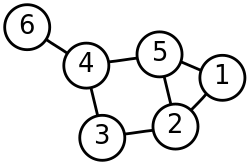 |
| Labeled simple Graph of 6 vertices and 7 edges |
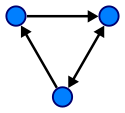 |
| An un-labeled Directed Graph |
Computer Representation of Graph :-
w(V) is an array of numbers w0,w1,...,wn-1.
w(E) is an 2-D array of numbers, called Adjacency Matrix A = ( w(x,y) ) where w(x,y) is the weight of edge (x,y) ∈ E. If edge is not present then w(x,y) = 0.
We can also, represent w(E) by an Adjacency List, where we have an array A, One element of A is another array A(x), which contains, ordered pair (w(x,y), y) sorted with respect to y.
This representation ease the search of edge as well as reduce the storage space in the sparse graph.
Note, that Adjacency List search time is O(log(n)), space complexity O(|V| + |E|). In Adjacency Matrix search time is O(1) but space complexity is O(|V|2).
 |
| Adjacency List Representation of directed and undirected graphs |
Again Hypergraph is a graph in which each edge is a k-tuple or set of k vertices, where k ≤ |V|.

No comments:
Post a Comment